A Living Kingdom

God’s Kingdom is meant to be a living Kingdom, living through you and me, as we follow Christ Jesus. I share this message with you to encourage you to surrender to God and then allow him to reign as King in your life – now and forever.

Lead Scripture:

Matt. 4:17 From that time Jesus began to preach, saying, “Repent, for the kingdom of heaven is at hand.

1. Jesus introduces his ministry with one phrase, “Repent, for the kingdom of heaven is at hand.”

2. What is the significance of this statement?

a. At the time, the pronouncement ushered in Jesus’ public ministry.

b. What about now?

i. Today, the words of Jesus are a clarion call to a new life. Jesus is pronouncing his victory over:

1. The kingdom ruled by Satan
2. The kingdom ruled by Man
3. The kingdom of ruled by Self

ii. He is inviting us to surrender to Him and share in this victory.

3. What is the kingdom of God/heaven?

a. Simple answer: The place where God reigns as King.

b. Consider what allegiance is owed a King . . .

i. In a 21st Century Democracy, we have a hard time with such concepts as “King” “allegiance” and “sovereign authority” because we are king and sovereign over our lives.

  • We decide what we will do, when we will do it and how we will do it. We do not take kindly to being told what to do. We claim “freedom” from any ruler and authority. Our allegiance, in the social contract, is first and foremost to ourselves.

ii. In the bible and other historical texts, a King is the absolute ruler of his kingdom.

  • The King is completely sovereign.
  • The King is the law and the authority.
  • The King owns the life of every subject and disposes of that life as he sees fit.

iii. There was never a situation where there are two sovereigns in one Kingdom. Such circumstance always resulted in war and the subjects would be required to proclaim allegiance to their king, fight for their king, and die defending their king.

iv. When a King prevailed over another King for sovereignty over a land and a people, the subjects of the conquered country would often be given a choice: Either surrender to the conquering King or die.

  • The decision to surrender subjected the people to a new King and his law, his rule, his will.
  • The life of the subject was, in effect, purchased.
  • The life of the subject was a gift of the king

4. When Christ calls us to “repent” what is he asking for?

a. Total and complete surrender to his Kingship over our lives.

i. Historically, surrender during a war occurs when soldiers, nations or other combatants stop fighting and eventually become prisoners of war, either as individuals or when ordered to by their officers.

  • A white flag is a common symbol of surrender, as is the gesture of raising one’s hands empty and open above one’s head.

ii. When the parties agree to terms the surrender may be conditional, i.e. if the surrendering party promises to submit only after the victor makes certain promises. Otherwise it is an unconditional surrender where the victor makes no promises.

  • Normally a belligerent will only agree to surrender unconditionally if completely incapable of continuing the fight.

iii. EXAMPLE: the 1862 Battle of Fort Donelson in the American Civil War. Brigadier General Ulysses S. Grant of the Union Army received a request for terms from the fort’s commanding officer, Confederate Brigadier General Simon Bolivar Buckner. Grant’s reply was that “no terms except unconditional and immediate surrender can be accepted. I propose to move immediately upon your works.”

  • When news of Grant’s victory—one of the Union’s first in the Civil War—was received in Washington, D.C., newspapers remarked (and President Abraham Lincoln endorsed) that Ulysses S. Grant’s first two initials, “U.S.,” stood for “Unconditional Surrender,” which would later become his nickname.

iv. EXAMPLE: 1 Kings 20:1-4, “And Ben-hadad the king of Syria gathered all his host together: and there were thirty and two kings with him, and horses, and chariots: and he went up and besieged Samaria, and warred against it. And he sent messengers to Ahab king of Israel into the city, and said unto him, Thus saith Benhadad, Thy silver and thy gold is mine; thy wives also and thy children, even the goodliest, are mine. And the king of Israel answered and said, My lord, 0 king, according to thy saying, I am thine and all that I have”.

  • As the great preacher Andrew Murray once pointed out when he taught from this passage, Ahab gave what was asked of him by Benhadad – absolute surrender.
  • He emphasized these words: “My lord, 0 king, according to thy saying, I am thine, and all that I have,” as the words of absolute surrender with which every child of God ought to yield himself to his Father.
  • Murray pointed out that the condition of God’s blessing in our life is absolute surrender of all into His hands. “Praise God! If our hearts are willing for that, there is no end to what God will do for us, and to the blessing God will bestow.”

b. The Kingdom of God has come and has vanquished all of the enemies who have challenged His absolute sovereignty:

i. Satan –defeated

ii. The kingdom of man – defeated

iii. You and I [our sin and rebellion] – defeated

  • We were once enemies of God.
  • By his grace, we are now his subjects. No, through the grace of God, we are more than subjects, we are called his children!

c. In the wake of God’s victory through the life, death and resurrection of Jesus Christ, God is calling for absolute surrender, “Repent, for the kingdom of God is upon you.”

5. Have we surrendered to God’s reign as King over our lives?

a. Are we at war with God?

b. Have we retained sovereignty over some aspect of our lives?

c. Have we placed conditions on our surrender?

6. What are some practical ways we can surrender to God and allow him to reign as King over our lives?

7. Surrendering to God’s reign over your life as King will open the door to a new Living and Eternal Kingdom

Joy: An Expression of God’s Life in Us

Ps. 13:1-6

1  How long, O LORD? Will you forget me forever?
How long will you hide your face from me?
2  How long must I take counsel in my soul
and have sorrow in my heart all the day?
How long shall my enemy be exalted over me?
3  Consider and answer me, O LORD my God;
light up my eyes, lest I sleep the sleep of death,
4  lest my enemy say, “I have prevailed over him,”
lest my foes rejoice because I am shaken.
5  But I have trusted in your steadfast love;
my heart shall rejoice in your salvation.
6  I will sing to the LORD,
because he has dealt bountifully with me.

Most of us can relate to the prayer raised to God in vs. 1-4. There are times in life when it seems like that God has forgotten us and he has hidden himself from us.

Consider for a moment the times when you have doubted God, when you have not seen evidence of God in your life, when you have been utterly alone. What was happening in your life? What were the circumstances you were facing? What was your disposition? What did you do to fill the void, to address the pain, and to bring yourself relief?

The Psalmist says that he overcame an enemy by trusting in the steadfast love of the Lord. Is that what you did? If yes, how did you apply the conviction of that trust to your situation? Did you survive or overcome?

The Psalmist also says that he rejoiced in God’s salvation. Rejoiced! Really? What is it about salvation that inspired joy he speaks about?

Unfortunately, many of us who have received God’s saving grace do not respond to our trails with trust, joy, rejoicing and/or a song.

Yet, a fruit of the Holy Spirit is “joy.” Galations 5:16-25

What is this “joy” that the scripture speaks about?

The bible speaks of this joy as the inspiration for running a race – a difficult race – with a great reward for those who finish.

THEREFORE THEN, since we are surrounded by so great a cloud of witnesses [who have borne testimony to the Truth], let us strip off and throw aside every encumbrance (unnecessary weight) and that sin which so readily (deftly and cleverly) clings to and entangles us, and let us run with patient endurance and steady and active persistence the appointed course of the race that is set before us.” Heb. 12:1.

Jesus ran the race perfectly. While it cost Him his life, he gave his life willingly and without reservation because he was inspired by something the bible calls “joy.”

Looking away [from all that will distract] to Jesus, Who is the Leader and the Source of our faith [giving the first incentive for our belief] and is also its Finisher [bringing it to maturity and perfection]. He, for the joy that was set before Him, endured the cross, despising and ignoring the shame, and is now seated at the right hand of the throne of God.” Heb. 12:2.

Notice this important point: The greatest trial anyone has ever faced was overcome for “joy.”

What inspires you as you walk through difficulty and trials? Is it joy?

As a fruit of the Spirit, joy is a visible expression of power working inwardly and invisibly, the character of the “fruit” being evidence of the character of the power producing it, Mat 7:16. As the visible expressions of hidden lusts are the works of the flesh, so the invisible power of the Holy Spirit in those who are brought into living union with Christ (Jhn 15:2-8, 16) produces “the fruit of the Spirit,” including the fruit of joy.

This joy is not something that can be produced through human will or effort or discipline or work.  Joy is not a “work of the flesh” but rather a product of the Spirit of God living in us and working through us.

Therefore, one who is led by the Spirit, and walking by the Spirit, will be someone filled with much joy in his or her life! It is a joy that can abide and remain, even when circumstances seem terrible. Paul knew this joy personally; he could sing when manacled in a dark prison dungeon! (Acts 16:25)

Barclay examining “eirene” the Greek word for joy, explained: “It is not the joy that comes from earthly things, still less from triumphing over someone else in competition. It is a joy whose foundation is God.”

Likewise, Charles Spurgeon once wrote, “Believers are not dependent upon circumstances. Their joy comes not from what they have, but from what they are; not from where they are, but from whose they are; not from what they enjoy, but from that which was suffered for them by their Lord.”

So, is God expressing his joy through your life?

If he is, consider some examples of God’s joy being expressed in and through you.  Praise Him for the good fruit he is producing in and through you.

If he is not, what is preventing you from walking in the fullness of His joy.  Doubt? Unbelief? Circumstances?

Maybe you have had a day, an hour or a moment when you were filled with his joy, but such joy, for you, was fleeting?

Whatever your experience, God wants to inspire, to grow and to express joy in your life.  I believe that “The joy” spoken about in scripture will become a expression of God’s life in us when we:

1) Have a clear revelation of who Christ is;
2) Have a clear revelation of who we are in Christ; and
3) When we abide in Christ.


1) Revelation of Who Christ is . . .

 
a. The effect of receiving revelation of who Christ is always joy:

 
i. Example #1 – Matt: 28:8, “So they went out quickly from the tomb with fear and great joy, and ran to bring His disciples word.”


ii. Example #2 – Luke 24-53: Then He said to them, “These are the words which I spoke to you while I was still with you, that all things must be fulfilled which were written in the Law of Moses and the Prophets and the Psalms concerning Me.” 45 And He opened their understanding, that they might comprehend the Scriptures. 46 Then He said to them, “Thus it is written, and thus it was necessary for the Christ to suffer and to rise[h] from the dead the third day, 47 and that repentance and remission of sins should be preached in His name to all nations, beginning at Jerusalem. 48 And you are witnesses of these things. 49 Behold, I send the Promise of My Father upon you; but tarry in the city of Jerusalem[i] until you are endued with power from on high.”50 And He led them out as far as Bethany, and He lifted up His hands and blessed them. 51 Now it came to pass, while He blessed them, that He was parted from them and carried up into heaven. 52 And they worshiped Him, and returned to Jerusalem with great joy, 53 and were continually in the temple praising and[j] blessing God. Amen.[k]


2) Revelation of Who we are in Christ . . .

 
a. God says that we are his joy

 
i. Matt. 13:44, “Again, the kingdom of heaven is like treasure hidden in a field, which a man found and hid; and for joy over it he goes and sells all that he has and buys that field.”


  • You and I are the treasure of the living God! He gave everything He had, even his own Son, to have an eternal relationship with us.

 
ii. Matt. 13:45-46, “Again the kingdom of heaven is like a man who is a dealer in search of fine and [p]precious pearls, Who, on finding a single pearl of great price, went and sold all he had and bought it.


  • You and I are the pearl of great price!!

 
iii. Luke 15-7; 10, “I say to you that likewise there will be more joy in heaven over one sinner who repents than over ninety-nine just persons who need no repentance. . . . Likewise, I say to you, there is joy in the presence of the angels of God over one sinner who repents.”


  • We are the “one(s)” who bring joy to heaven through our repentance.

 
iv. “He, for the joy that was set before Him, endured the cross, despising and ignoring the shame, and is now seated at the right hand of the throne of God.” Heb. 12:2.


  • Jesus endured the Cross for you and I. You and I were the “joy” set before him. It brought God pleasure to save us!!!


3) Abiding in Christ – John 15:1-11


1″I am the true vine, and my Father is the vinedresser. 2 Every branch in me that does not bear fruit he takes away, and every branch that does bear fruit he prunes, that it may bear more fruit. 3Already you are clean because of the word that I have spoken to you. 4 Abide in me, and I in you. As the branch cannot bear fruit by itself, unless it abides in the vine, neither can you, unless you abide in me. 5 I am the vine; you are the branches. Whoever abides in me and I in him, he it is that bears much fruit, for apart from me you can do nothing. 6If anyone does not abide in me he is thrown away like a branch and withers; and the branches are gathered, thrown into the fire, and burned. 7If you abide in me, and my words abide in you, ask whatever you wish, and it will be done for you. 8 By this my Father is glorified, that you bear much fruit and so prove to be my disciples. 9 As the Father has loved me, so have I loved you. Abide in my love. 10 If you keep my commandments, you will abide in my love, just as I have kept my Father’s commandments and abide in his love. 11These things I have spoken to you, that my joy may be in you, and that your joy may be full.


THE FEAR OF THE LORD

Dear Friend, here are my notes from a message I delivered regarding the fear of the Lord.  I pray this message will cause your heart to cleave to the life and love we have in God.

Lead Scripture:

Philippians 2:12-18

12 Therefore, my beloved, as you have always obeyed, so now, not only as in my presence but much more in my absence, work out your own salvation with fear and trembling, 13 for it is God who works in you, both to will and to work for his good pleasure.
14 Do all things without grumbling or questioning, 15 that you may be blameless and innocent, children of God without blemish in the midst of a crooked and twisted generation, among whom you shine as lights in the world, 16 holding fast to the word of life, so that in the day of Christ I may be proud that I did not run in vain or labor in vain. 17 Even if I am to be poured out as a drink offering upon the sacrificial offering of your faith, I am glad and rejoice with you all. 18 Likewise you also should be glad and rejoice with me. [1]

Questions to Consider:

1. What is your salvation? What do we have to work out?
2. What does it mean to “fear” and to “tremble” before the Lord?
3. What is the relationship between the fear of the Lord and the Joy of the Lord?

I. What is our “salvation”?

1.  Saved from the consequences of sin [All have sinned Romans 2:23-26]:

  • Death [Romans 6:23]
  • Wrath of God/Judgment [Romans 1:18-32]
  • Broken relationship with God

2.  Saved to . . .

  • To worship God [Ex. 7:16 “Let my people go so that they may worship me . . .”]
  • To reveal to all God’s creation the love and grace of God [Romans 1 “The creation waits in eager expectation for the sons of God to be revealed; Hebrews – even the angels marvel what is being revealed about God through us]
  • To bring God Glory [Eph. 1:11-14]

3.  Salvation is a gift, not something that has been earned. Eph. 2:1-9

  • No magic words.
  • No club of like minded good people.
  • No merit badges or special honors
  • See Phil 3:1-9 – Paul denounces righteousness by works.

4.  Well then, if salvation is a gift, what is their to “work out?”

  • We must work “to know” the one who gave us the free gift of salvation.
  • We must work at sharing in his life – which includes sharing in his suffering and sharing in his joy
  • Paul is pleading with us to live the life of a person who has been saved!!

II.  What does it mean to “fear” the Lord and to “tremble” before him?

First, we must not candy coat this phrase – Fear means Fear.
a.  Greek = φόβος “phobos” [Pronunciation fo’-bos]; From a primary phebomai (to be put in fear); Outline of Biblical Usage = fear, dread, terror (that which strikes terror)

b.  Vines says:

  • Fear, Fearful, Fearfulness: first had the meaning of “flight,” that which is caused by being scared; then, “that which may cause flight.”
  • “fear, dread, terror,” always with this significance in the four Gospels; also e.g., in Act 2:43; 19:17; 1Cr 2:3; 1Ti 5:20 (lit., “may have fear”); Hbr 2:15; 1Jo 4:18; Rev 11:11; 18:10, 15;
  • that which causes “fear,” Rom 13:3; 1Pe 3:14, RV, “(their) fear,” AV “(their) terror,” an adaptation of the Sept. of Isa 8:12, “fear not their fear;” hence some take it to mean, as there, “what they fear,” but in view of Mat 10:28, e.g., it seems best to understand it as that which is caused by the intimidation of adversaries.
  • Terror: “fear,” is rendered “terror” in Rom 13:3; in 2Cr 5:11; 1Pe 3:14, AV (RV, “fear”).

c. Hebrew = פַּחַד “pachad” [Pronunciation = pakh’·ad]; Outline of Biblical Usage = terror, dread, object of dread

Second, despite this “fear” and “terror” God commands that we draw near to him and that we do not “shrink back.” Hebrews 10:37-38.

a. Remember you are saved from His wrath!

b. Go back to the key scripture and you will see Paul reminds us of this point when he says, “it is God who lives and works in you both to will and to work for his good pleasure.“ Phil. 2:13

c. Saints – God lives in you! And He is working in you!!

Third, the presence of God in us necessarily inspires a firm and abiding fear.

Q: Why?

A: God is holy and we are not.

Let’s consider some examples of those who have been in the presence of God.[2]

  • The People of Israel at Mt. Sinai. Ex. 19, 20, 32-34.
  • Job. Job 38-42
  • King David – Psalms.
  • The Prophet Isaiah. Isaiah 6.
  • The Apostles: a. Apostle Peter. Restored; b. Apostle Paul. Knocked off his horse. c. Apostle John. Revelation [Rev. 1]

In considering the foregoing examples, I want you to recognize that the fear of God:

1. Exposes sin, depravity and rebellion.

2. Creates despair – I can’t do this on my own – I need a savior!

3. Compels Surrender to God

4. Inspires Comfort/Consolation from knowing that, despite our sin, God loves us and has provided a way for us to enter into a relationship with Him, that is to say, he has made a way for his presence to abide with and in us.

5. Causes Transformation – new life, new heart, new mind.

6. Results in Glory to God – worship, ministry, action

7. **** Causes a desperate desire not to let anything break our relationship with God.

BEWARE: DO NOT SHRINK BACK, DO NOT BE DISCOURAGED AND DO NOT SETTLE FOR SUBSTITUTIONS. Phil. 2:14-16

Summary: The fear of the Lord is a terror of being separated from God, that is, to be cut off from our relationship with Him. Hence, to work out our salvation with fear and trembling is to live our lives according to God’s good will and pleasure. We must work “to know” the one who gave us the free gift of salvation. We must work at sharing in his life – which includes sharing in his suffering and sharing in his joy. We must live the life of a person who has been given the great gift of salvation.

Shout it from the roof tops – Tell all your friends and family:

The LORD is my God! He is slow to anger and abounding in steadfast love, forgiving all my iniquity and transgression! The LORD is gracious and compassionate, slow to anger and rich in love. God is for us! God is for us! No one can stand against us? He did not spare his own Son but gave him up for us all! God has justified me! Christ Jesus died for me, but much more, he has been raised from the dead and now sits at the right hand of God and he is interceding for us. His holy spirit lives in me!!! He lives in me!!! I am a new creation!!!! Nothing shall separate me from the love of Christ – no tribulation, no distress, no persecution, no famine, no nakedness, or danger, or sword? No!!!!! In all these things, I am more than a conquerors through the great God who him who loved me. For I am sure that neither death nor life, nor angels nor rulers, nor things present nor things to come, nor powers, nor height nor depth, nor anything else in all creation, will be able to separate me from the love of God in Christ Jesus our Lord.”

III. What is the relationship between the fear of the Lord and the joy of the Lord?

1.  Fear of the Lord results in joy.

2.  Fear of the Lord inspires us to live out our purpose and call to glorify him as we love one another.

3.  We take on the mind of Christ [Phil. 2:1-11] We love one another. [1John 3:16-22; 4:7-11]

4.  Consider how those who love God pray? Always for others? Always with love –taking on the sins of others as if those sins were their own, and seeking forgiveness and reconciliation for all.

IV. WHAT ABOUT YOU AND I

The bible says, “[It is] a fearful thing to fall into the hands of the living God.”
– Hebrews 10:31

NEVERTHELESS, THERE IS NO OTHER IN WHOSE HANDS I WOULD RATHER BE!

Don’t Let Your Love Grow Cold

canstockphoto3039358

Dear Reader, are you:

  • disillusioned about some aspect of your life,
  • struggling with unanswered questions of the heart and head,
  • heart broken,
  • struggling with hypocrisy of one form or another,
  • feeling judgmental,
  • angry with God,
  • suffering from the fruits of false beliefs,
  • going through the motions in life with a veneer exterior, but feeling a void in you soul because your life lacks substance.

If any of the foregoing describes you and what you are feeling, I just want you to know I am praying for you. As I pray, I want to encourage you to stand firm in your faith and do not let your love, the love that God has placed deep within you, to grow cold.

The bible says that, “And [in that day] many will be offended and repelled and will begin to distrust and desert one another and will stumble and fall away and betray one another and pursue one another with hatred. And many false prophets will rise up and deceive and lead many into error. And the love of [b]the great body of people will grow cold because of the multiplied lawlessness and iniquity, but he who endures, overcomes and stands firm to the end will be saved.” Matt. 24:10-13.

Life is full of many challenges and controversies. Indeed, in a day and age where it seems one evil or another abounds through out the world, it is easy to allow our hearts to be filled with fear. This fear manifests itself in different ways in different people, but it always leads a person to the same lonely place.

Many who allow fear a foothold into their heart and mind become isolated or distracted or busy with activity hoping that the fear will go away. Others seek to fill the void fear creates with some material thing or some unhealthy relationship.

Everyone who embraces fear in one form or another seeks to hide the fact that they are afraid, while simultaneously doing whatever it takes to find a place of safety and security. Hence, fear causes people to become “offended” by those who love them and those they are given to love and they become filled with distrust for one another.

Thereafter, a person who was once filled with faith, hope and love, is transformed into an unstable soul, hating everything that has eternal worth and cleaving to what ever temporal happiness that will numb the unrelenting pain. To be certain, there are many who claim to have insight, authority and special enlightenment and preach a convenient gospel of cheap grace and happy living, but these false prophets are setting the fearful up to become so cold to love – love for God and love for one another – that they become paralyzed and ineffectual.

There is no fear in love. But perfect love drives out fear, because fear has to do with punishment. The one who fears is not made perfect in love.” 1 John 4:18.

Fear is the opposite of love. Just like light and darkness, love and fear cannot occupy the same space. However, be encouraged, just like light always overcomes darkness, love always overcomes fear.

As I pray, I get the sense that someone who is reading this post needs to know that they are not alone. Today, that someone is me. And so from my prayer closet, I submit the following encouragement and exhortation:

  • To the disillusioned: if your vision for life is blurred and you have lost your way, cleave to the love of God and he will speak peace to the tempest and the storm that brews with in you.


  • To those tormented by questions: let love be your teacher and fill your heart and mind with wisdom.


  • To the heart broken: let love flood into your heart to heal you, to restore you and to fill you with joy.


  • To the hypocrites: let love be the plumb line by which you measure your actions. Do what you know to be right and turn away from what you know to be wrong.


  • To those who have been injured by the hypocrite: let love remind you of your own failings and weakness so you can bestow grace upon grace to that double-minded person; forgive just as you have been forgiven. Unconditionally.


  • To the judgmental: let love convert your critical thoughts into a prayer and intercession. May love give you strength to bear the burden of the sin you are judging as if it where you own. Don’t stop praying until you are both delivered.


  • To those who are angry with God: let love remind you that you are precious to Him. Let love help you take every indictment you have against Him to the Cross. Indeed, measure everyone of frustrations about what God has done (or not done) against every wound, scare, and drop of blood shed for you. Rest. Quietly. He knows.


  • To those suffering from the fruits of false beliefs: let love purify your soul and set you free from guilt and shame. You are accepted just as you are. There is nothing you have done or can do that can cause God to love you more than he does now. Let love cut through the cloud of doubt and give you clarity.


  • To those who feel like they are faking it and who are longing for all that is real: let love become your identity. Find your significance in the perfect love of God and in sharing that love with those he brings into your life.

If you need any additional prayer and encouragement, please don’t hesitate to call or write.

(If you are struggling with what the meaning of “love” is, please read my post “Love = A Poured Out Life”)

Mercy Tree

As Easter approaches, I find myself reflecting on the Cross and the death and new life that come from it.  I can’t quite put into words the overwhelming feeling it is to be confronted by the love of God found in Christ Jesus.  As I pray, the Spirit within me groans and all I can do is worship.  Recently, I learned this song by Lacy Sturm:

On a hill called Calvary
Stands an endless mercy tree
Every broke and weary soul
Find your rest and be made whole

Stripes of blood that stain its frame
Shed to wash away our shame
From the scars pure love released
Salvation brought the mercy tree

In the sky, between two thieves
Hung the blameless Prince of Peace
Bruised and battered, scarred and scorned
Sacred Hands pierced by our thorns

It is finished was his cry
The perfect Lamb was crucified
The sacrifice, our victory.
Our Savior chose the mercy tree

Hope went dark that violent day
The whole earth ‘quaked at love’s display
Three days silence in the ground
This body born for Heaven’s crown

On that bright and glorious day
Heaven opened up the grave
He’s alive and risen indeed
Praise him for the mercy tree

Death has died. Love has won!
Hallelujah! Hallelujah!
Jesus Christ has overcome.
He has risen from the dead.

Death has died. Love has won!
Hallelujah! Hallelujah!
Jesus Christ has overcome.
He has risen from the dead.

One day soon we’ll see His face
And every tear, He’ll wipe a way
No more pain or suffering
Oh, praise him for the mercy tree

Death has died. Love has won!
Hallelujah! Hallelujah!
Jesus Christ has overcome.
He has risen from the dead.

Death has died. Love has won!
Hallelujah! Hallelujah!
Jesus Christ has overcome.
He has risen from the dead.

On a hill called Calvary
Stands an endless mercy tree

Listen for yourself and sing along in worship and praise for all that God has done:


Wait for the Lord

The message in this post is for those who recognize and struggle with doubt, fear, failure, disappointment and inadequacy.

More specifically, this message is for you if you are having trouble with sin in your life.  Perhaps, recently, in the hour of testing, you have been too weak to resist temptation and have fallen into one vice or another?  Maybe you have fought against this particular sin vigorously, but you have been defeated? Consequently, you are now ashamed because you can’t seem to break free from the grip that this sin has on your life.

This message is for you if you are struggling with unbelief.  Maybe you are ashamed to say it aloud, but in your heart you are asking, “Is God real? or Am I making this God up in my head or believing something that is just a product of my imagination?”

This message is for you who do not trust God?  I know this may be hard to admit for some. Christians are supposed to trust their God, but, nonetheless, there are times when you do not trust him.  Perhaps you do not trust Him because of some trial you are going through? Perhaps, while going through this trial, you do not sense His presence and he does not appear to be answering you? Maybe you have expected God to do something – answer a prayer, bless you or someone you love in a certain way, provide for you, or just show up in your life in a way that you can truly feel and know Him?  However, despite much prayer and great attempts to trust Him, your expectations have not been satisfied.

This message is for you who have made some commitment to God, but haven’t been able to carry through.  Maybe you have promised to pray more or read the bible more or to dig in deeper to the call God has on your life, but you feel impotent and discouraged because you can’t seem to keep your promise.

This message is for you who don’t know what God is calling you to do or are confused about your calling and purpose in life.

This message is for you who are at a crossroads in life.  Perhaps you need to make a major decision and do not know what to do. Sometimes choices you are faced with are both good options for your life, but you don’t know which choice is right.  Alternatively, sometimes both choices are bad, but you do not know what to do other than make the best of a bad situation.

This message is for you who have been hurt deeply by someone you love.  Maybe you have been betrayed, lied to, physically or mentally abused, or ___________________ [fill in the blank]

This message is for you who are facing a problem that is too great for you.  Maybe you sense that you don’t have the strength to push it through?  Maybe life has become a burden too heavy to bear? You feel too tired to try to go on. You are at a place where you just want to get away, change or die.

THE MESSAGE I HAVE TO SHARE WITH YOU FROM GOD’S WORD IS TO “WAIT”

Isaiah 40:27-31: • 27 Why, O Jacob, do you say, and declare, O Israel, My way and my lot are hidden from the Lord, and my right is passed over without regard from my God? • 28 Have you not known? Have you not heard? The everlasting God, the Lord, the Creator of the ends of the earth, does not faint or grow weary; there is no searching of His understanding. • 29 He gives power to the faint and weary, and to him who has no might He increases strength [causing it to multiply and making it to abound]. • 30 Even youths shall faint and be weary, and [selected] young men shall feebly stumble and fall exhausted; • 31 But those who wait for the Lord [who expect, look for, and hope in Him] shall change and renew their strength and power; they shall lift their wings and mount up [close to God] as eagles [mount up to the sun]; they shall run and not be weary, they shall walk and not faint or become tired.
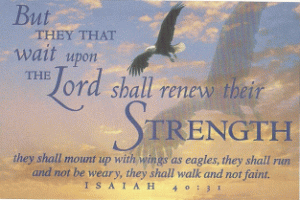
pocket_cards_wait_upon_the_lord

Right now you might be saying, “Great, Jason, thank you for the encouragement.  ‘Wait.’  Very helpful. I am drowning in despair and you tell me to wait (sarcastic sigh).”

I understand.  Please stay with me a moment while I explain.

WHAT DOES IT MEAN TO, “WAIT FOR THE LORD”?

1.   When God Tells You To Wait, He Wants You “To Hope” In Him.

One of the Hebrew words for “wait” is “yachal” (Strong’s 3176) which also means to hope for, to expect, to await, to tarry for and to trust.   Read and meditate upon the following usages of “yachal” (in bold):

  • 1Sa 10:8 – And thou shalt go down before me to Gilgal; and, behold, I will come down unto thee, to offer burnt offerings, [and] to sacrifice sacrifices of peace offerings: seven days shalt thou tarry, till I come to thee, and shew thee what thou shalt do.
  • Psa 69:3 – I am weary of my crying: my throat is dried: mine eyes fail while I wait for my God.
  • Job 13:15 – Though he slay me, yet will I trust in him . . .
  • Psa 31:24 – Be of good courage, and he shall strengthen your heart, all ye that hope in the LORD.
  • Psa 33:18 – Behold, the eye of the LORD [is] upon them that fear him, upon them that hope in his mercy . . .
  • Psa 33:22 – Let thy mercy, O LORD, be upon us, according as we hope in thee.
  • Psa 38:15 – For in thee, O LORD, do I hope: thou wilt hear, O Lord my God.
  • Psa 42:5, 11 – Why art thou cast down, O my soul? and [why] art thou disquieted in me? hope thou in God: for I shall yet praise him [for] the help of his countenance.
  • Psa 71:14 – But I will hope continually, and will yet praise thee more and more.
  • Psa 119:43 – And take not the word of truth utterly out of my mouth; for I have hoped in thy judgments.
  • Psa 119:49 – Remember the word unto thy servant, upon which thou hast caused me to hope.
  • Psa 119:74 – They that fear thee will be glad when they see me; because I have hoped in thy word.
  • Psa 119:81 – My soul fainteth for thy salvation: [but] I hope in thy word.
  • Psa 119:114 – Thou [art] my hiding place and my shield: I hope in thy word.
  • Psa 130:5 – I wait for the LORD, my soul doth wait, and in his word do I hope.
  • Psa 130:7 – Let Israel hope in the LORD: for with the LORD [there is] mercy, and with him [is] plenteous redemption.
  • Psa 131:3 – Let Israel hope in the LORD from henceforth and forever.
  • Psa 147:11 – The LORD taketh pleasure in them that fear him, in those that hope in his mercy.
  • Lam 3:24 – The LORD [is] my portion, saith my soul; therefore will I hope in him.
  • Mic 7:7 – Therefore I will look unto the LORD; I will wait for the God of my salvation: my God will hear me.

Having mediated on the foregoing passages, you should come to the inescapable conclusion that waiting “for” or “on” the Lord means to place your hope in God and God ALONE.

Hope.

Waiting = Hope.

Hope.  [selah]

hope-in-focus

Think about the word “Hope” for a moment and be real with yourself when you answer these two questions:

What do you place your hope in?

Is your hope in our Lord or in someone or something else?

While you think through the answers to these questions, let me propose something to you:  all hope – what ever it is we hope for or in is defined by receiving the fulfillment of some promise.  Life, death, health, wealth, peace, love, friendship, success, comfort, freedom, etc.  The only reason we have hope in these things is because there is some promise that we may receive them.

Perhaps the better question is who do we hope in?

Every promise has a source.  Who is the one making the promise that you are hoping for or in?

Hope is always defined by a promiser and a promise.  Without a promiser and a promise, there is no hope. Stated another way: Hope does not exist without a promise and the person who makes the promise.  Indeed, our hope is really only as strong as the assurance we have in the person who has made us a promise.  If you know the person making you a promise is unable to deliver on his or her promise, then the hope you have in receiving what is promised is in vain.   However, if you know the person who makes you a promise is able to deliver on his or her promise, then you have substantive hope that you will receive what you have been promised.

Hope guides our thoughts, feelings and actions.  We all have hope.  Again, I believe the question is who and what do we place our hope in?  Perhaps a related question is: how reliable is our hope?  Is it a vain and desperate hope in one who can’t deliver? or Is our hope substantive and sure because the person we have placed our hope in can deliver on his promise?

Do you hope in the promise of a man?

Do you hope in the promise of the world?

Do you hope in the promises you make to yourself?

Do you hope in Satan’s promise?

Do you hope in the promise of God?

I know all of us desire to say that our hope is in God and his promise.  Perhaps . . . However, let’s  briefly consider each promisor and promise and allow the Holy Spirit speak to us about where our hope truly is so that we can redirect it to the one who provides us the best hope.

PROMISE OF MAN

What are the promises of man? What I mean is: are there promises that people have given you that you place your hope in?  For example, in a marriage there is a promise between a husband and a wife.   In employment, there is a promise of an employer to an employee. Parents offer the  promise of care, love and support to their children.  A farmer promises that, if he plants a seed and waters it, it will grow.  A bank promises to keep your money safe.

Think of people in your life and what they have promised you? What is the promise? What are the terms of the promise? Do you believe you receive what has been promised? Why do you believe you will receive what has been promised?

PROMISE OF THE WORLD

What is the promise of the world?  I believe we can sum up the promise of the world in one word: “success.”  Here are some definitions of “success”:

  • the favorable or prosperous termination of attempts or endeavors.
  • the attainment of wealth, position, honors, or the like.
  • a successful performance or achievement: The play was an instant success.
  • a person or thing that is successful: She was a great success on the talk show.
  • Synonyms: achievement, fame, triumph, winning
  • a winner

Are you driven by the promise of success? Who is the source of the promise?  What is your assurance the person will deliver on the promise?

PROMISE TO YOURSELF

What promises do you make yourself?

Goals: I will ________ [fill in the blank]

Dreams: Before I die, I want ________ [fill in the blank]

Are you self-reliant? What assurance do you have that you will be able to deliver on the promises you make to yourself? Do you pursue your agenda for life and ask God to bless it?  Do your goals and dreams supersede the plans God has for your life?  How do you tell the difference between your promises and the promises of God?

PROMISE OF SATAN

In the bible, Satan is well-know for making several kinds of promises.   I will summarize them into four categories:

  1. Satan promises that you and I will be equal to God if we eat the forbidden fruit of the knowledge of good and evil rather than the tree of life.
  2. Satan promises that he can give us dominion and power if we worship him.
  3. Satan promises we can live by our own will and resources apart from the word of God.
  4. Satan promises us that God owes us something and that we should demand from Him payment of what we have coming to us by right.

The foregoing promises are exemplified in Genesis 3 and Matthew 4; however, when ever the bible describes Satan at work on humanity, one of these promises or a variation of one of these promises is at play.  What needs or emotions do such promises appeal to? Have you placed your hope in any one of these promises? What assurance do you have that Satan can deliver on anything he promises?

WAITING IS THE PROCESS OF WEIGHING AND RELYING UPON THE SUBSTANCE OF OUR HOPE – JESUS CHRIST OUR LORD

One might argue that the foregoing promisers and promises are not evil in and of themselves.  Indeed, one might argue that for man to to give and receive promises is good and can fulfill Christ’s command to love oneanother.  Another might argue that being successful in this world can bring a certain joy and fulfillment in life and can allow us to be an effective witness to the goodness of God.  Still another might argue that setting goals and having dreams can bring a certain level of inspiration and purpose in this life and glorify God.  Finally, one might argue that God really doesn’t mean what he says and that he is unreliable to deliver on His promise.  I have known many people who charged God with being unreliable because of some disappointment in not receiving something from Him for which they felt entitled.  However, God’s promise of new life in Him can not be chained to human pride and selfishness.

“Indeed, let God be true but every man a liar. As it is written:

“That You may be justified in Your words,
And may overcome when You are judged.”

(Romans 3:4)

Do you see the deception and distraction of placing another hope ahead of the hope we have in God and his promise? More often than not, I would submit to you that our temporal hope supersedes the hope we have in God and His promise.  Consequently, we struggle and despair in life because we have entrusted ourselves to a hope we have in the promises of man, the world, ourselves and, perhaps, the devil himself.

Any hope that usurps the hope we have in God and His promise is a vain hope.  Man’s promise is limited.  The world’s promise is empty.  The promises you make to yourself can only achieve what you are capable of doing.  Satan’s promises can only lead to eternal damnation.

Ultimately, any hope beyond the hope we have in God and his promise is idolatry and will result in bondage to sin, emptiness, suffering, pain and, in the end, death.  We must not mix any other hope [promisers and the promises] with the hope we have in God and his promise.  As Christians, we often try to fit God and his promise into the promises we have received from man, the world or promises we have made ourselves.  However, the consequences of combining our temporal hope with our eternal hope will always be frustration, disillusionment and/or apostasy.

So, in summary, when God tells you to wait, God is asking you to place ALL your hope in Him and His promise.  Notably, our faith is partly defined by our hope as expressed in Hebrews 11:1 “Now faith is the assurance of things hoped for, the conviction of things not seen.”  Dear friend, God loves you with a jealous affection. “Or do you suppose that the Scripture is speaking to no purpose that says, The Spirit Whom He has caused to dwell in us yearns over us . . . with a jealous love?” James 4:5.  So, don’t place your hope in another and, “May the God of hope fill you with all joy and peace in believing, so that by the power of the Holy Spirit you may abound in hope.”  (Rom. 15:13)

images-4

2.   When God Tells You To Wait, He Wants You To Be Patient In The Hope He Has Placed Upon Your Heart.

One of the greek words for “wait” is “hypomonē” (Strong’s 5281) which also means steadfastness, constancy, endurance, patience and perseverance.  Read and meditate upon the following usages of “hypomonē” (in bold):

  • Luk 8:15 – But that on the good ground are they, which in an honest and good heart, having heard the word, keep [it], and bring forth fruit with patience.
  • Luk 21:19 – In your patience possess ye your souls.
  • Rom 8:25 – But if we hope for that we see not, [then] do we with patience wait for [it].
  • 2Th 3:5- And the Lord direct your hearts into the love of God, and into the patient waiting for Christ.
  • Hbr 10:36 – For ye have need of patience, that, after ye have done the will of God, ye might receive the promise.
  • Hbr 12:1 – Wherefore seeing we also are compassed about with so great a cloud of witnesses, let us lay aside every weight, and the sin which doth so easily beset [us], and let us run with patience the race that is set before us.
  • Jam 1:3 – Knowing [this], that the trying of your faith worketh patience.
  • Jam 1:4 – But let patience have [her] perfect work, that ye may be perfect and entire, wanting nothing.
  • Jam 5:11 – You know how we call those blessed (happy) who were steadfast [who endured]. You have heard of the patience and endurance of Job, and you have seen the Lord’s [purpose and how He richly blessed him in the] end, inasmuch as the Lord is full of pity and compassion and tenderness and mercy.
  • Rev 3:10 – Because you have guarded and kept My word of patient endurance [have held fast the lesson of My patience with the expectant endurance that I give you], I also will keep you [safe] from the hour of trial (testing) which is coming on the whole world to try those who dwell upon the earth. 11 I am coming quickly; hold fast what you have, so that no one may rob you and deprive you of your crown.

As you have mediated on these passages and considered your own life experiences, I trust you have come to the same conclusion  I have, to wit, waiting on the Lord is not easy.   I don’t think patience would be patience if waiting on the Lord was easy.   Waiting on the Lord takes a lot of time – sometimes many years.  However, if we love God like the people applauded for their faith in Hebrews Chapter 11, we will trust in His ability to keep His promise and patiently wait.    Even when we feel like we don’t have the strength to wait, God himself will provide you and I with strength to wait.

But how?  Good question.  The answer leads to my third, final and favorite point about what He means when God tells you to wait.

images-1

3.  When God Tells You To Wait, He Wants You To Bind Yourself To Him.

Another Hebrew word for “wait” is qavah {pronounced “kayvah”}.   This is the word used in the lead scripture for this message, Isaiah 40:31, “But those who wait for the Lord . . . “

Many bible teachers and scholars focus their translation on the concept of actively waiting or expectantly waiting for someone or something, i.e., a child wating on Cristmans morning for Mom and Dad to wake up to pen presents, a thief hiding on the side of the road waiting for someone to pass.

However, I would like to draw your attention to the primitive root translation of this word, which is “to bind together.”  In this regard, the Hebrew word means to “to twist, to bind – i.e. to whence a rope.”  This concept of “waiting” is closely related to the concept of strength (that is, to be strong and robust) as used in scripture because the word conveys the notion of binding something together – like a rope.   To bind together means to tie the parts of something together, i.e., to tie a number of things or people together or, in chemistry, it means to combine with, form a chemical bond with, or be taken up by, as an enzyme with its substrate.

images

My favorite illustration of this concept comes from a personal experience I used to have with my son, Robbie, when he was a toddler.  Although he could walk, his legs were too weak to take him very far, especially if his mom and I went hiking or on a trip that required a lot of walking.  He would get frustrated and cry walking with his mom and I because it was very difficult for him and his short little legs to keep up.  He needed strength – my strength – to go the places I was going and see the things I was seeing.   Indeed, the chances of keeping up with us were hopeless if he relied upon his own strength.   So what did we do?  He bound himself to me in a backpack.  The backpack was specially made for a child of his size to fit into.  He could securely be strapped in and fit snugly on my back.  This would allowed my son to appropriate a strength that was not his own so that he could go where I would go and see what I would see.  Effortlessly, my strength became his strength and we could experience life together.

Likewise, when God tells us to wait for him, he is telling us to bind ourselves together with Him and He will become our strength.   This is good news because waiting on God does not require us to be strong.  It simply requires us to bind ourselves to Him.  His strength becomes our strength and we can experience His life with Him.

[selah]

Now, with this concept of waiting fresh in your mind, let us revisit Is. 40:31 and replace the term “wait” with the concept to bind yourself to:

 But they that [bind themselves] upon the LORD shall renew [their] strength; they shall mount up with wings as eagles; they shall run , and not be weary ; [and] they shall walk, and not faint.

I was always puzzled by this scripture and how in waiting I would renew my strength and have wings as eagles and run and not be weary and walk and not be faint until I understood that waiting was an invitation to bind myself to God so that he could be my strength.

Consider some of these other scriptures that utilize the same concept and be encouraged that the Lord your God is inviting you to bind yourself to Him and live by His life and His Strength:

  • Psa 25:3 – Yea, let none that [bind themselves] on thee be ashamed: let them be ashamed which transgress without cause.
  • Psa 25:5 – Lead me in thy truth, and teach me: for thou [art] the God of my salvation; on thee do I [bind myself] all the day.
  • Psa 25:21 – Let integrity and uprightness preserve me; for I [bind myself] on thee.
  • Psa 27:14 – [Bind yourself] on the LORD: be of good courage, and he shall strengthen thine heart: [Bind yourself], I say, on the LORD.
  • Psa 37:9 – For evildoers shall be cut off: but those that [bind themselves] upon the LORD, they shall inherit the earth.
  • Pro 20:22 – Say not thou, I will recompense evil; [but][bind yourself to] on the LORD, and he shall save thee.
  • Isa 25:9 – And it shall be said in that day, Lo, this [is] our God 430; we have [bound ourselves to] him, and he will save us: this [is] the LORD; we have waited for him, we will be glad and rejoice in his salvation.
  • Lam 3:25 – The LORD [is] good unto them that [bind themselves to]  him, to the soul [that] seeketh him.
  • Hsa 12:6- Therefore turn thou to thy God: keep mercy and judgment , and [bind yourselves] on thy God continually.

Therefore, if you are having trouble with sin in your life, bind yourself to the Lord your God, indeed bind yourself to His cross, and he will give you strength in your hour of testing.  “No temptation has overtaken you except such as is common to man; but God is faithful, who will not allow you to be tempted beyond what you are able, but with the temptation will also make the way of escape, that you may be able to bear it.” (1 Cor. 10:13)

If you are struggling with unbelief, close the ears of your heart to the voices that plague you and bind yourself to the hope God has promised you in Himself because he is faithful. (Heb. 10:23) As the Apostle Paul exhorts us in Romans Chapter 4, look at the example of Abraham who, “In hope he believed against hope, that he should become the father of many nations, as he had been told, “So shall your offspring be.” He did not weaken in faith when he considered his own body, which was as good as dead since he was about a hundred years old), or when he considered the barrenness of Sarah’s womb.  No unbelief made him waver concerning the promise of God, but he grew strong in his faith as he gave glory to God, fully convinced that God was able to do what he had promised.” (Rom. 4:18-21)

If you are going through some trial  and you do not sense His presence and he does not appear to be answering you, stop looking to your circumstances and bind your eyes to your glorious Lord. He is the answer to your heart’s cry and he will not let you be overcome by the storm. (Matt. 14:27)

If  you don’t know what God is calling you to do or are confused about your calling and purpose in life, take heart because He knows you intimately. (Ps. 139) He says He knows you so well that he has even numbered the hairs of your head. (Luke 12:7) Bind yourself to Him and His life in you will lead you and guide you into His purposes for you. (2 Peter 1:2-4)

If you have been hurt deeply by someone you love, betrayed, lied to, physically or mentally abused, know that the Lord promises that He is near to the brokenhearted.  (Ps. 34:18) Indeed, our Lord understands because he Himself, ” . . . was despised and rejected by men; a man of sorrows, and acquainted with grief; and as one from whom men hide their faces he was despised, and we esteemed him not.” (Is. 53:3)

So, having considered what it means to “wait” on the Lord, let me leave you with a few questions:

  • What keeps us from waiting – binding ourselves to – the Lord?
  • What are some of the the consequences of not waiting on the Lord?
  • What are some of the benefits of waiting on the Lord?

Send me your answers to these questions.  I would love to hear from you.

Growing pains . . .

My son, do not make light of the Lord’s discipline, and do not lose heart when he rebukes you, because the Lord disciplines the one he loves, and he chastens everyone he accepts as his son. . . No discipline seems pleasant at the time, but painful. Later on, however, it produces a harvest of righteousness and peace for those who have been trained by it.” (See James 1:2-12)

In my walk with the Lord, I think I have faced the Lord’s loving correction several times.  Typically, he lights the fire of discipline through my relationships.  I always seem to do or say something that offends one person or hurts another. “Oh, wretched man that I am!! God deliver me for this body of death! I thank God—through Jesus Christ our Lord!”  (Romans 7:24-25)

The good news is that God’s discipline is an expression of His great love for us.  I think the difficult thing for us to do when we are disciplined is to humble ourselves and receive what God is telling us with joy and anticipation.   God is transforming us into vessels that can receive and give more love than you could ever ask for or imagine.

I would like to share with you an episode from life as an example.  I shared this on Facebook two years ago as a note and, recently, this message resonated with some friends of mine who were experiencing conflict in their fellowship.  I hope and pray that you will be as blessed as I have been through what God has taught me about who He is, who I am in Him and how to love those he puts into my life.

***

One Sunday, I got up and delivered a word of exhortation to the fellowship of believers in Jesus Christ that I worship with every week.  The word was well received from what I was told, encouraging to many, and what I had shared seemed to be right on point with what our Pastor had prepared for his message.

However, little did I know that I had deeply offended a friend I have been going to church with for twenty years.   A few days later, on Wednesday, my friend sent me a measured note via e-mail complaining, not about what I said, but the manner in which I had said it.  In this regard, he explained that he felt like I had disrespected our Pastor by speaking to the church without getting his permission before the service.  He then told me that a “policy” had been implemented while I was in Kenya for this type of speaking and that the policy prohibited people from spontaneously getting up and delivering any kind of message without being invited to do so by the Pastor.

Of course, I was perplexed and confused by this rebuke because (1) our pastor had always allowed me the freedom to speak whenever I had the unction of the Holy Spirit to do so; and (2) I did not know about the “policy.”  My flesh and pride wanted to fight, but the spirit within me said to pray.  So, I prayed.   Specifically, I asked God to show me what, if anything, I had done wrong.  I expected God to tell me I was right and to give me words to rebuke the “friend” who had presumptuously judged my motives and actions.  Instead, and quite unexpectedly, I received a gentle but resolute rebuke from my Heavenly Father.

As I prayed about the issue that my friend had raised and asked the Lord what he was saying through the e-mail message my friend had sent me, God spoke into my heart the following passage from the book of James, “Therefore submit to God. Resist the devil and he will flee from you. Draw near to God and He will draw near to you.”  (James 4:7-8)   When I opened my bible to read what I had been spoken to me, I noticed that the chapter from which this passage in scripture comes from actually begins with a question, “What causes wars and fights among you?”   In answer to that question, James describes worldly desires that wage war within us.  In church circles, we often consider worldly desires in a materialistic sense and ignore how the application of this scripture addresses relationships within the church.  However, as we know, “the heart is deceitful above all things” and, even when we have good motives, sinful desires rooted in pride crop up to divide believers.

For hundreds of years, Satan has divided churches and pit brother against brother over various ideas on what the bible says about how the church should be run.  Indeed, people have a tendency to use the bible as a set of rules and regulations for what they believe is righteous and orderly living, to control and judge how others live and act, and to discriminate amongst who gets “in” to their group and who is excluded; however, such a view of scripture is limited and worldly.

Scripture is not a book of rules and regulations for lawyers and theologians to parse through and spew about.  Rather, Scripture is the embodiment of Christ Jesus. (See John Chapter 1).  As such, Scripture is life giving and life changing because the words are living words that transform our life into His life and our character into his character.  As Jesus said, “You study the Scriptures diligently because you think that in them you have eternal life. These are the very Scriptures that testify about me,  yet you refuse to come to me to have life.”  The purpose of scripture is to bring us into the Love of God and to teach us how to love one another.   If we use the word of God for any other purpose, then the result is always bondage.

Hence, in responding to my friend’s concerns about what I had done at church, I had to ask God to guard my heart against the fleshly need to defend myself.  In asking for God to do this, he told me to submit to Him.  As I submitted myself to Him and His great love, God revealed to me that part of my friend’s motive in raising his concern was to protect our Pastor and the pulpit from being usurped and undermined in some way.  My actions appeared to my friend to be inappropriate because they appeared to disrespect my Pastor and the reverence that he believed should be given for the authority that comes with the office of a pastor.  I respect my friend and his role in our church and I appreciated his efforts to protect our Pastor. However, I was deeply concerned that my friend did not give me the benefit of the doubt with respect to my motives and actions.

Nonetheless, I explained to my friend that I have no desire to usurp or undermine our Pastor or his Office.  God gave me the grace to apologize and repent for the confusion my actions may have created in my friend and others.  God, through my wife, showed me that I probably should have come to church early or called the day before and asked the Pastor for permission to deliver a word of exhortation.

I then asked God to sift my heart in this matter because I believe I heard Him give me permission to interrupt the service in the way that I did.  In so doing, God did not convict my heart of any ill-motive or desire.  I respect my Pastor and give deference to his authority.  Over the years, I have always believed we have had a relationship of mutual respect that resembles a father-son relationship in many regards.  For the last 20 years, I have faithfully followed his lead as my pastor, friend and brother and I have respected his decisions even when I have not always agreed with him.  It is in the context of this relationship that I have exercised authority to speak in church, whether it is reading a word from scripture, delivering a word of exhortation or delivering a sermon.  There have been times when I have not spoken to my Pastor before church and made eye contact with Him during the flow of a service and/or asked permission to minister to the body in some way.  Sometimes Pastor has waived me off or gently said not right now and other times he has set me free to minister as the Holy Spirit has led.

That said, it is important to understand that my actions in the church have always been bridled by my relationship with my Pastor, not by rules and regulations he has imposed upon me.  Our relationship is marked by trust, respect and love for one another and our love for God and His people.    As scripture says, “Therefore be imitators of God as dear children.  And walk in love, as Christ also has loved us and given Himself for us, an offering and a sacrifice to God for a sweet-smelling aroma. . . . be filled with the Spirit, speaking to one another in psalms and hymns and spiritual songs, singing and making melody in your heart to the Lord, giving thanks always for all things to God the Father in the name of our Lord Jesus Christ, submitting to one another in the fear of God.”  (Eph. 5:1-2; 19-21)  I think the trust Pastor gives the people he serves makes the ministry he has been given different from other pastors because that trust allows for freedom in our fellowship.  Although this freedom can be messy from time to time and the people under our Pastor’s care may make mistakes in exercising their freedom, this freedom allows people to grow in and contribute to the community of believers from week-to-week.  Over the years, my Pastor has taught me that churches are not organizations defined by charters and bylaws, they are communities defined by people and relationships.

I think the thing that hurt me the most about my friend’s judgment of my actions is that it called into question my love, trust and respect for my Pastor and the love, respect and trust he has in me.  Additionally, his judgment revealed a substantial lack of love, trust and respect for me.  My friend made several assumptions about what I did and said and why I said what I said that concerned me because it revealed that he did not know me well enough to trust that I would not do anything to usurp Pastor’s authority or to disrespect the office of the Pastor.

The Holy Spirit inspired me not to blame my friend for this circumstance.  The Lord convicted my heart and led me to take full responsibility and repent for the lack of fellowship we have had.  As I honestly assessed myself with the help of the Holy Spirit, I realized that I had not made myself available to develop a deeper relationship with him.  Unfortunately, one of my weaknesses is that I have a tendency to be superficial in my relationships.  I may have many friends, but there are few who really know me.  Basically, my fellowship with “my friend” is confined to those instances when we see and greet each other at church and those occasions I attend the men’s breakfast.  Since I began attending my Pastor’s church in 1992, I don’t think I have had any fellowship with “my friend” outside these circumstances. I am embarrassed that I have allowed so much time to pass without building a stronger friendship with “my friend.”  I suspect I have weak relationships with others in our fellowship that I call “friend” as well.  Consequently, there are probably others who have questions about what I do, what I say and what motivates me.

Through this experience, I realized that I need to grow past my natural tendency to settle for superficial relationships if I am going to be a servant and encourager of God’s people. I don’t think those who are called to serve God’s people should be superficial and I do not think that they should be so distant from the people they serve that those people do not trust them.   I can’t do this without God transforming me.  Please pray for me in this regard because I desperately want to follow Christ in his command that I love my brothers and sisters as he has loved me.  (John 15:12)  I want be just like Christ in “laying down my life for my friends.” (John 15:13)  I also want to bear the fruit of his Spirit in my character and in my relationships.

In the context of what I have just said, please take a moment to reflect on 1 John 4:7-10 , “Beloved, let us love one another, for love is of God; and everyone who loves is born of God and knows God. 8 He who does not love does not know God, for God is love. 9 In this the love of God was manifested toward us, that God has sent His only begotten Son into the world, that we might live through Him. 10 In this is love, not that we loved God, but that He loved us and sent His Son to be the propitiation for our sins. 11 Beloved, if God so loved us, we also ought to love one another.

Isn’t this an amazing truth?!  Our love for God and knowledge of God is not measured by what we do or what we say in church?! It is measured by the love we have for one another!  The evidence of His life living through us is the love we give to one another.  Jesus emphasized this point when he said, “By this shall all men know that ye are my disciples.”  John 13:35.   So, while I may be able to speak, prophesy, exhort and teach, if I do not possess love and if love does not possess me, my words are just noise and my actions are meaningless.  (I Cor. 13)

Even when it is painful to my ego, I am thankful for God’s discipline in my life.  My character has several defects and needs to be transformed.  I have so much to learn in life and I need God’s Spirit to teach me.   I am thankful that God has used this lesson as another opportunity for me to grow into His image and likeness and to learn to love those he puts in my life in both word and deed.

God’s Favorite Place on Earth

Frank Viola’s new book, God’s Favorite Place on Earth, has just released. If you get the book between May 1st to May 7th, you will also receive 25 FREE books from over 15 different authors.

Click GodsFavoritePlace.com to ordering information and easy instructions on how to get your 25 free books.

GFP3Dlarge

Recommendations

“In Frank Viola’s hands, the story of Lazarus—like Lazarus himself—once again comes to life. In a world where hope is battered and life can so easily beat down the human spirit, we are reminded once more of the possibility of becoming a host of Life.”

John Ortberg, pastor and author of Who Is This Man?

God’s Favorite Place on Earth realigned my heart toward Jesus and His mysterious, confounding, surprising, beautiful ways. It’s not often I learn something new when reading a book, but Frank Viola’s sharp storytelling and insightful interpretation made me hunger for more of the real Jesus.”

Mary DeMuth, author of Everything: What You Give

“God’s Favorite Place on Earth is the kind of book I’ve discovered I need to periodically find and read. Frank Viola’s pen and voice are consistently both penetrating and trustworthy. Beyond his invitingly beautiful writing skill—which makes reading a joy and a sight-seeing tour that brings God’s Word into 3-D when he relates narrative passages, I’m grateful for the depth of his themes.”

Pastor Jack Hayford, Chancellor of The King’s University, Los Angeles

“This is a masterfully engaging book that distills the vision of the Christian life into one focused quest: To be God’s favorite place on earth today. I recommend this little volume to all Christians and Christian leaders.”

Mark Batterson, New York Times bestselling author of The Circle Maker

“Combining masterful storytelling, historical knowledge, biblical insight and practical wisdom, Frank artfully uses the Gospels’ depiction of Lazarus and the small town of Bethany to lay out a beautiful and compelling vision of a God who longs to make every human heart and every church ‘His favorite place.’ This is a beautifully written, timely, prophetic work all would benefit from reading!”

Greg Boyd, pastor and author of Benefit of the Doubt

“A lot of people write books, Frank writes stories and in this one we once again see why he’s such a master. Honored to call him a friend, excited to call him an author I love to read.”

Jon Acuff, bestselling author of Start, Quitter, and Stuff Christians Like 

“Frank Viola surpasses himself in his best book yet—a work of serene, soaring magnificence. Part novel, part biography, part theology, part Bible study, Frank’s imaginative touch and command of prose haiku leaves the reader resolved more than ever to be a Bethany—God’s favorite place on earth.”

Leonard Sweet, Drew University, George Fox University, sermons.com

“Reading God’s Favorite Place on Earth by Frank Viola, my soul began to burn from Chapter One. To delve into Lazarus’ heart and thoughts … I received a beautiful glimpse into the life of Christ on earth. Lazarus’ stories make a perfect foundation for God’s truth, God’s intimacy. I can’t wait to share this book!”

Tricia Goyer, USA Today best-selling author of 35 books

“In spite of my Ph.D. in Theology, I had never considered the importance of Bethany in the life of Jesus.”

Phil Cooke, media consultant and author of Unique

“The best thing I can say about Frank Viola is this: When I read his books—and I read them all—I don’t think much about Frank Viola. I think about Jesus. And I learn to love Him more. This book is no different. Read it, and you’ll find yourself thinking, if you’re like me, ‘I knew Jesus was great, but… Wow!’ And that, at least from me, is as good as it gets.”

Brant Hansen, Radio personality and blogger 

See all 47 Recommendations at GodsFavoritePlace.com 

Check out the book sampler and share it with others: http://frankviola.org/GodsFavoritePlace.pdf

Check out the short video trailer and share with friends: http://www.youtube.com/watch?v=RG_9TeE-BO8